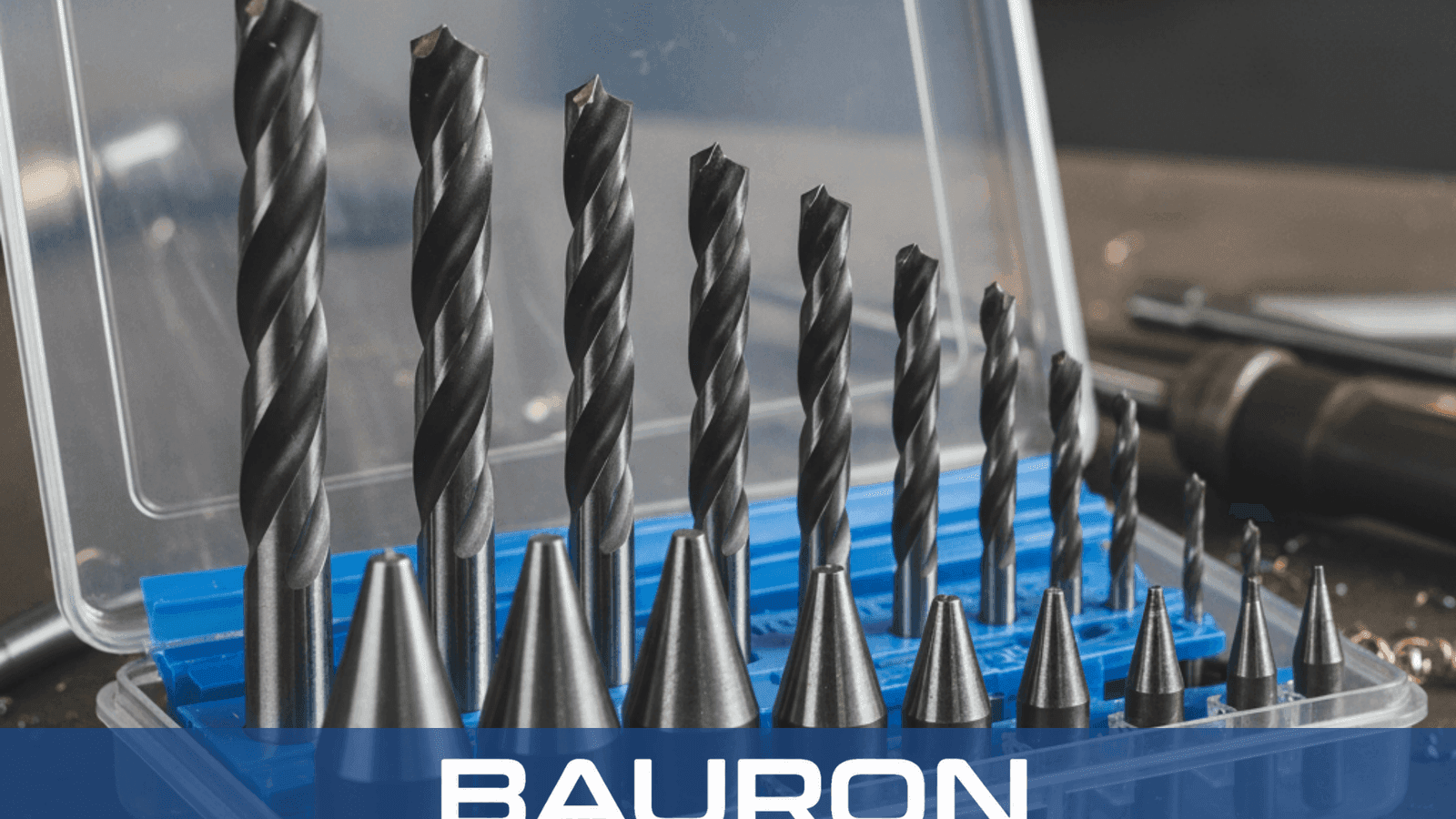
Conical Seating
The taper drill base is pressed firmly into the matching female spindle taper.

Taper shank drills are high-rigidity hole-making tools designed explicitly for heavy industrial machinery. Utilizing a conical tapered shank (typically a Morse taper), these bits press directly into matching machine spindles without requiring a drill chuck, completely eliminating tool slippage during heavy, high-torque cuts.
The taper drill base is pressed firmly into the matching female spindle taper.
Precise angular contact creates a powerful, concentric friction fit that holds the tool securely.
The flattened tang end at the top of the shank engages the spindle drive slot to prevent spinning under heavy loads.
Deep helical flutes shear heavy volumes of metal while carrying chips smoothly out of the bore.
Eliminates drill chuck runout and slippage, ensuring maximum concentricity and torque transfer.
Features a hardened flat tang that engages the machine drive slot, preventing tool rotation under extreme loads.
Heavy core construction withstands massive downward feed pressures without flexing.
Fits directly into standard Morse Taper spindles (MT1 through MT6) or adapter sleeves.
Deep, polished flutes efficiently eject heavy metal chips from deep bores.
| Specification | Range / Details |
|---|---|
| Diameter Range | 1/8" to 4"+ (Standard and metric large-diameter sizes) |
| Shank Type | Morse Taper (MT1, MT2, MT3, MT4, MT5, MT6) |
| Point Angle | 118° (Standard) or 135° (Split Point for hard metals) |
| Flute Geometry | Standard Spiral (Right-Hand Cut) or Parabolic |
| Tolerance | Precision ground to exact H7 or OEM industrial standards |
| Operation Type | High-torque, direct-spindle heavy drilling |
| Material / Coating | Best For | Key Advantage |
|---|---|---|
| HSS (High-Speed Steel) | Structural steel, mild steel, and cast iron. | Outstanding impact toughness to absorb heavy shock loads during deep cuts. |
| Cobalt (HSS-Co) | Stainless steel, titanium, and hard alloy steels. | Superior thermal resistance prevents cutting edges from dulling under intense heat. |
| Black Oxide Coating | General heavy steel fabrication. | Retains cutting fluid at the point of cut and protects against rust and galling. |
HSS supplies impact toughness for heavy cuts, cobalt improves thermal resistance in hard alloys, and black oxide retains cutting fluid while protecting against rust and galling.
The primary machine for these tools, providing the massive downward thrust required for large taper shank drills.
Industrial stationary machines utilizing direct Morse taper spindle mounting for precise, large bores.
Mounted directly into tailstock spindles to bore accurate centers in heavy rotating stock.
Bores large-diameter clearance holes in thick structural steel plates and I-beams using heavy-duty taper shank drill bits.
Drills deep cylinder, oil, and coolant passages in cast iron engine blocks with zero tool deflection.
Utilizes robust taper drill bits on radial arm presses to drill through massive hull plates.
Executes high-torque, large-diameter hole creation on heavy industrial machinery frames.
Straight shank bits rely on three-jaw drill chucks, which can slip or spin when subjected to extreme rotational torque. Taper shank drill bits mount directly into the machine's tapered spindle, using friction and a drive tang to transfer 100% of the machine's torque without slipping.
To remove a taper drill, you insert a wedge-shaped steel tool called a "drift key" into the horizontal slot on the side of the machine spindle. Lightly tapping the drift key with a hammer pushes against the flat tang at the top of the shank, safely ejecting the bit.
Morse Taper is an industry-standard conical dimension system numbered MT1 through MT6. Smaller diameter taper drill bits use smaller shanks (e.g., MT1 or MT2), while massive bits use larger shanks (e.g., MT4 or MT5) to match the corresponding spindle size of the heavy machinery.
Yes. You can use hardened steel adapter sleeves (reduction sleeves or extension sockets) to step up or step down the shank size, allowing a smaller MT2 bit to fit into a larger MT4 spindle seamlessly.
Yes. Bauron specializes in custom CNC tools. We can engineer custom taper shank drills with specialized point angles, extended flute lengths, coolant-through channels, or advanced TiAlN coatings tailored to your exact heavy industrial applications.
Bauron provides design and engineering support for application-specific tooling requirements. Share the geometry, material, coating needs, and machining challenge for technical review.
Talk to Engineering